

Phoebe’s Grief and the Failure of Friends
.png)
When my brother died, I turned to watching old sitcoms.
It started in the early fog of shock and survival mode: I was curled up in a hotel room in Mexico next to one of my sisters, where we were waiting to gather my brother’s belongings. Our other sister, the Spanish-speaking one, was having to actually spearhead communication with local professionals in the midst of the loss. As we mindlessly clicked through the streaming options, looking for any way to take our minds off the horror, we landed on Seinfeld; we’d never seen it. We ended up keeping it on all night long as we moved in and out of the nightmares of sleeping and waking. Kramer, big salads, and Art Vandalay saw us through those early weeks.
Once I got home to my apartment in Maryland, I started Schitt’s Creek. This one, though it had ended its run, was more squarely of my generation. I reveled in the ridiculousness of the Roses and ultimately loved it for its sweetness, too, but what kept me in it, really, was that, like Alexis, my brother’s name was David, and I just wanted to hear his name over and over again.

Over the next couple of years, I’d continue to mix in the older stuff with my “regular regimen” (read: Abbott Elementary and baking shows). I kept feeling drawn to sitcoms I’d missed, as if going back in time a bit would allow me to totally tune out from the reality of the current day I was living in — the one without David here.
***
This past Spring, I started watching Friends for the first time.
One of my best friends in college was an avid Friends fan; in fact, thanks to her, “mini wave in celebration of me” was part of our clique’s lexicon. (See “The One With the Football.”) At that time, I had no context; I had only seen a couple of episodes here and there, and those mostly in the background. Fifteen years later, sitting down to watch Friends felt like a homage to that college bestie.
Not only that, but since it was twenty-two years since its final episode had originally aired, streaming it in a few short weeks felt like a focused peek into an ethos that shaped the culture I inherited as a white young person — a feeling backed up by facts. Friends viewers really were mostly white during its original run, so when Friends is credited with defining a generation’s idea of what family is and what youth is for, much of this angle can and should be credited to Living Single, which introduced this premise before Friends ever arrived on the scene. To say it defined a generation is a whitewashed oversimplification. That said, I think it’s safe to say it heavily influenced everything about white pop culture, down to a viral haircut called “The Rachel.” Wikipedia’s page on Friends delineates its original viewership as over 20 million every single season; moreover, for every single season it was ranked in the top 10; actually, for every single season but the first, it was ranked in the top 5. Its finale is widely known to be the fifth most-watched finale in US history.
***
Like the millions of viewers before me, I quickly fell in love with the Central Perk crew in all their idiosyncrasies: Typically, I identify as adamantly anti-spoiler, but I surprised myself by asking Google early on whether Ross and Rachel would end up together. I loved Joey as much as the next person, and I actually tried to stop watching after “The One with the Proposal” because I thought there could not possibly be a better ending for Monica and Chandler. But after a brief pause, I returned to see everybody through.
As for Phoebe, meeting this queen of quirky for myself for the first time was like being hit with a wave of recognition: Wow, here is a woman who is in touch with her grief.
Note Phoebe’s ability to so openly name her grief in the very first episode of the very first season of Friends:
(CUT TO THE GANG AT Monica Rachel’S, SITTING AROUND A TABLE. ON THE TABLE ARE Rachel’S CREDIT CARDS and A PAIR OF SCISSORS)
Monica : C’mon, you can’t live off your parents your whole life.
Rachel : I know that. That’s why I was getting married.
Phoebe : Give her a break, it’s hard being on your own for the first time.
Rachel : Thank you.
Phoebe : You’re welcome. I remember when I first came to this city. I was fourteen. My mom had just killed herself and my step-dad was back in prison, and I got here, and I didn’t know anybody. And I ended up living with this albino guy who was, like, cleaning windows outside Port Authority, and then he killed himself, and then I found aromatherapy. So believe me, I know exactly how you feel.
Phoebe goes there!
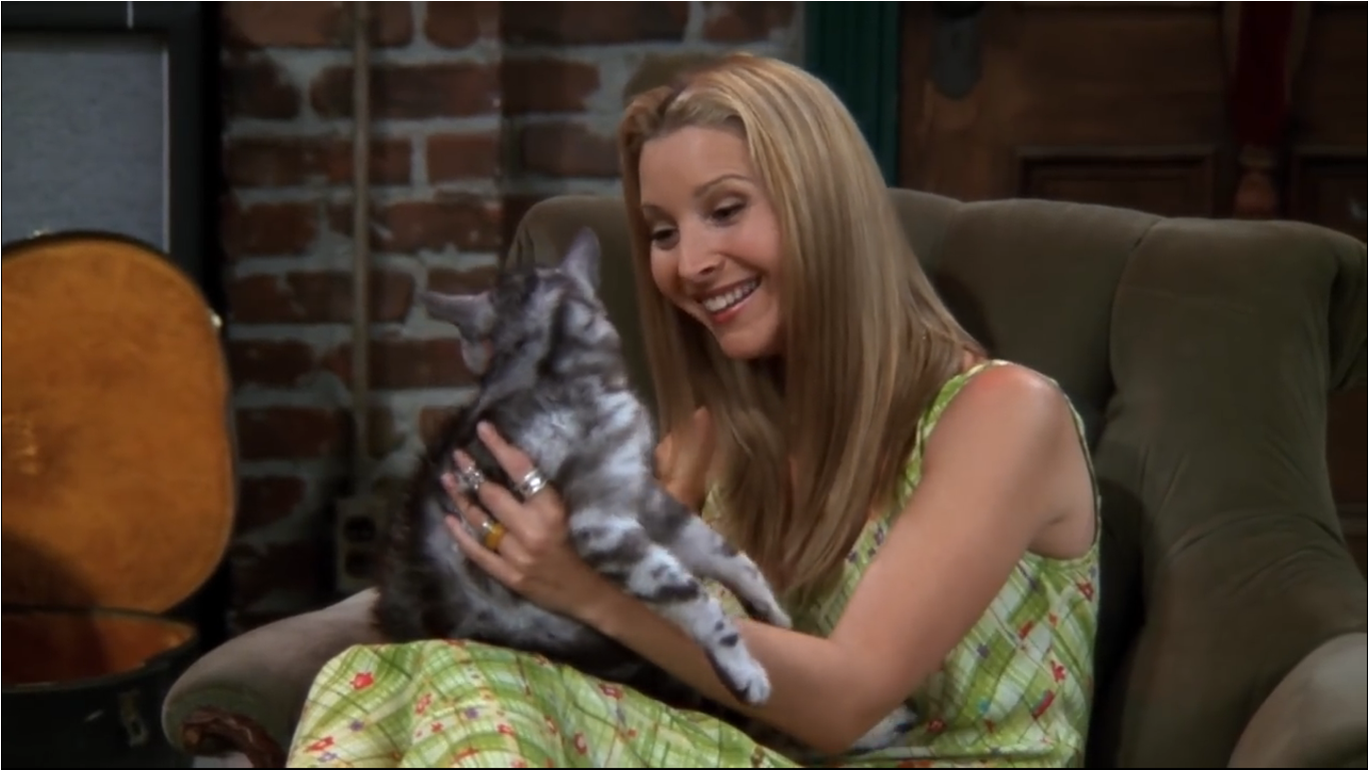
For me, this moment felt like catharsis. I’ve always known subconsciously—and have more recently experienced consciousl—that white American culture teaches us to tiptoe or freeze around grief, leaving it up to the griever to exert the effort to name it. It’s exhausting work to layer on top of our already confusing existences in this world without our loved ones. So, when I heard Phoebe name her grief without a trace of hesitation, I experienced a sense of release and hope.
After all, the truth is, all I really ever want to do is talk about my brother David. Well, that’s not quite true. What I really want is for him to be here: to know he’s walking around on this planet, feel grounded by that knowledge, ask his advice at random times, and send him funny videos. But since that’s not possible, what I want most is to assert his presence in a space; I want other people to know he existed. And I want to connect with others authentically, which means being honest about the grief with which I live and reminding them, like Annie Sklaver Orenstein points out in her work Always a Sibling, yeah, I have a brother.
It often feels like such hard work to make him visible to others, but Phoebe makes mentioning her lost loved ones look easy. Plus, she does it without a trace of narcissism. In fact, the beginning and end of her tiny monologue are offerings of connection and compassion to Rachel. They are an effort to relate — causing the next few lines to feel like a harsh twist and all-too-familiar splash of cold water:
(A PAUSE)
Ross : The word you’re looking for is ’Anyway’...
Monica : You ready?
Rachel : I don’t think so.
Ross : C’mon, cut. Cut, cut, cut,...
All : Cut, cut, cut, cut, cut, cut, cut... (SHE CUTS THEM All UP. THEY CHEER)
Her friends just move on. They don’t acknowledge any part of what she said for the rest of that scene. It’s worth noting that it’s not Rachel, the new friend, but Ross and Monica, who have known Phoebe the longest, who change the subject and move to protect Rachel from Phoebe’s perceived awkwardness — even though the conversation was already serious, and no one needed protection.
First, I felt seen in Phoebe; then, I felt ignored with her.
***
As the series continues, Phoebe’s relationship with her family members — deceased and otherwise —continues to prove complicated, but her largely static personality rolls with the punches, and her equally static friend group never gets better at receiving the grieving side of her. Beginning with the awkward studio audience laughter sweetened with laugh track edited into the quoted scene above, the writers continually leverage Phoebe’s pain as a source of controversial dark humor. This fascinating Reddit thread grapples with this choice, with one user pointing out that she mentions her dead mom at least once in every season. Another Reddit thread, titled “Please explain to me the humor in Phoebe’s mom’s suicide,” reasonably calls this running joke into question. In this one, users debate characters’ responses to Phoebe in “The One with the Cat,” some sharing their own experiences with grief.
As others point out, Phoebe isn’t meant to be a source of pathos of the show, and I’m not certain I would wish her to be. (For sweet and tender shows about grief and friends who make loving space for it, we have Somebody Somewhere.) But I’m more upset than I care to admit by how painfully grief-illiterate Phoebe’s friends are. These are her people, and they are very, very, very bad at making space for her grief.
This might not be a big deal if Friends wasn’t such a cultural powerhouse, but it is. In 2014, Willa Paskin wrote a piece for Slate in which she notes, “the reason [Friends] has aged so well: “Not only is it relatively timeless for a sitcom, watching Friends turns you into a friend, initiated into the ins and outs of their relationships and personalities.” Her point here is an important one. Because viewers become a part of the friend group, we pick up their tendencies. Friends writers are officially credited with coining the term “Friendzone,” for heaven’s sake! And Friends is consistently named as one of the most popular shows to watch when learning English for the first time. Friends is how people learn white US culture.
So, while, yes, humor is sometimes a way to navigate pain, through the responses (or, more often, lack thereof) offered by Monica, Ross, Rachel, Joey, and Chandler, the audience of Friends is trained — over ten consecutive years of entertainment and perceived intimacy with these characters — to respond to grief with discomfort and avoidance.
***
Around the time I started watching the show a few months ago, I saw a colleague holding a mug bearing the iconic Friends logo with a quip like “Thanks for being the Rachel to my Monica.” Finally able to get the joke, I shared that I was just getting around to watching Friends for the first time, and my coworker kind of grimaced: “Yeah,” she said, “it hasn’t aged that well.”
As I watched, I couldn’t disagree. There are plenty of attempts at humor in Friends that, in 2026, read as politically incorrect or tone-deaf at best and outright problematic or offensive at worst, and watching the series since Matthew Perry’s death lends a painful brilliance to his performance. However, it’s striking to me that the particular aspect of life as a grieving person—represented by Phoebe and her grief-phobic friends—feels untouched by time. I could walk into a group of friends in a coffee shop today and mention my brother’s death, and it would not be unlikely for me to receive the exact same response Phoebe gets.
A 2021 study published by the Public Library of Science and headed by Dr. Joanne Cacciatori, herself a bereaved mother, reported that only 25% of grievers are extremely satisfied with their friends’ support. In fact, they regularly rate pets as more supportive. (This certainly is reflected in Phoebe’s character! 🐱)
Has Friends made all of us worse friends?
***
To be clear, I recognize the grief-avoidant Friends reflex in myself as well. Just the other day, a neighbor told me that his dog died, and I literally was not able to find any words. I just stood there awkwardly, exuding not compassion but confusion. A few weeks later, a student told me of a loss of a beloved elder that left her reeling, and I nodded sympathetically but moved on from it quickly to discuss grades. I am bad at this, too.
In fact, one of the most humbling parts of this for me is reflecting on my relationship with my friend from college—the one who loved the show. We were a part of a friend group not unlike that of Friends — we spent all our time together freshman year, and a few of us became couples. We practically spoke an alternate language with each other, dependent largely on inside jokes, and we had more than our share of toxic patterns. One of the worst ones? Failure to honor and treasure each other’s grief. This particular friend lost her dad before coming to college, and I don’t remember ever, ever inviting her to share more about him or about her experience in the context of that loss. I just accepted it as a fact of her life and moved on— I did to her then what, now, I don’t want anyone to do to me.
***
In real-life friendships, we usually recognize one another’s complexity. We fight through real challenges.
Unlike Friends, which ends when someone buys a house and someone else gets married, we accompany each other through multiple life stages. And unlike Seinfeld, we hug. We know that we are allowed to change, and we strive to be there for each other through thick and thin. At our best — and, honestly, even just at our most mediocre — we certainly don’t stereotype one another into rigid boxes and canned roles.
So why do we settle into such shallow, sitcommy ways of holding each other in grief?
***
In losing my brother, I began to realize for the first time what an immense and ineffable gift it is to share life with another human. I am who I am because he was who he was, and he was who he was in ways that spanned every particular of his presence — from the way he would speak volumes with just a raise of the eyebrow to the way he would emit a bark of laughter, glide down the soccer pitch, or sit in the stillness of the sunrise. I can’t believe I got to belong to him and he to me. It is too profound for comprehension.
Looking back, I know that he had more than his fair share of grief, too, and I didn’t really make an effort to know that side of him. I didn’t know how much it mattered. I missed out.
I wonder what it would take for us to imagine new ways of being there for each other. What would it mean for us to offer more embodied and unflinching witness of one another’s embodied presence — including our pain and the lost people who have shaped us?
How can we rewrite the script?
If we were to use Meg Devine’s How to Help a Grieving Friend as a starting place, we might be the friend at the kitchen table who doesn’t say ‘Anyways…’, who doesn’t deflect the grief or, worse, feed on it, but who lets it exist as a sacred offering. We might make a little more room for each other. We might express sincere gratitude for what is shared. We might honor one another more fully.
And we might offer each other a little more awe.
***
As a griever, I hope to be bold in unapologetically bringing in my beloved dead into the conversation. I hope to be understanding and to soften into compassion for all beings. I hope to be one who belongs to my dead while being fully and freely myself. I hope to be joyful and creative and quirky and confident and honest and fun and angry. I hope to have good boundaries and lots of rest while being expressive and full of life. I hope to be like Phoebe.


.png)
.png)
.png)

:upscale()/2014/07/28/928/n/1922283/128289b500c74a64_orig-21241972.gif)
:upscale()/2014/07/28/929/n/1922283/412311b640a38197_tumblr_m6cgg9eo6h1ro2d43.gif)